India's Financial Architecture Transformed: A Retrospective on the 2008 Global Crisis and Regulatory Fortification
The 2008 global financial crisis, though US-born, profoundly impacted India's markets, capital flows, and trade, leading to pivotal reforms like the IBC and stronger banking safeguards.
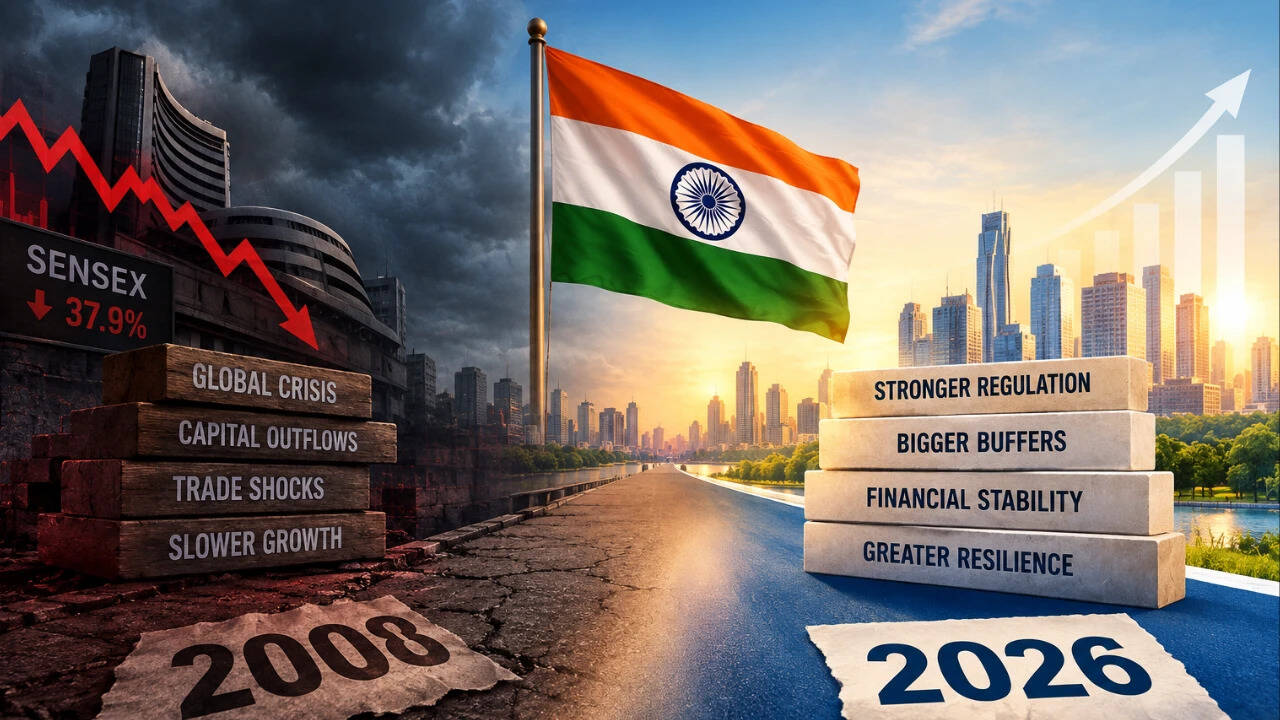
Table of Contents ▼
- Initial Shockwaves: Market Contagion and Capital Flow Reversals
- India's Banking Sector: A Pillar of Unexpected Resilience
- Financial Markets & Capital Allocation Alert: Exposing Gaps in Resolution and Regulation
- Post-Crisis Reforms: The Insolvency and Bankruptcy Code and Systemic Safeguards
- Long-Term Implications for Capital Markets and Corporate Governance
- Frequently Asked Questions
- Official Reference & Verification
Eighteen years after the seismic tremors of the 2008 global financial crisis originated in the United States, India's financial landscape stands significantly re-engineered. The crisis, while born offshore, rapidly transmitted its contagion to the Indian economy, primarily manifesting through disruptions in financial markets, a sharp reversal in capital flows, and notable impacts on international trade, as detailed in recent analyses.
Despite these formidable external pressures, a key characteristic of India's response was the inherent resilience demonstrated by its domestic banking system. This robustness, however, did not obscure underlying structural vulnerabilities. The shock served as a critical catalyst, exposing discernible gaps in the nation's financial resolution mechanisms and its regulatory oversight framework. This period of introspection and urgent reform subsequently paved the way for a series of transformative policy interventions.
Among the most significant of these post-crisis reforms were the introduction of the Insolvency and Bankruptcy Code (IBC) and the implementation of more stringent safeguards specifically designed for systemically important banks. These measures were not merely reactive; they represented a fundamental recalibration of India's approach to financial stability, corporate governance, and the broader capital markets ecosystem, aiming to fortify the nation against future global economic dislocations.
Initial Shockwaves: Market Contagion and Capital Flow Reversals
The 2008 global financial crisis, despite its genesis in the US subprime mortgage market, rapidly propagated across interconnected global financial systems. For India, the primary transmission channels were immediate and impactful: a pronounced volatility in its capital markets, a significant deceleration and subsequent reversal of institutional inflows, and a discernible contraction in trade volumes. The interconnectedness of global finance meant that even without direct exposure to the toxic assets at the heart of the crisis, India's equity and debt markets experienced sharp corrections, reflecting a global flight to safety and a re-pricing of risk.
This period saw a marked shift in investor sentiment, with foreign institutional investors (FIIs) recalibrating their allocation strategies, leading to outflows that exerted downward pressure on asset prices and increased sovereign yields. The impact on trade, while less direct than the capital market shock, was equally significant. As global demand contracted and supply chains faced disruption, India's export-oriented sectors experienced headwinds, contributing to broader macroeconomic uncertainty. The crisis underscored the vulnerability of emerging economies to external shocks, particularly those reliant on global capital for growth and trade for economic expansion.
India's Banking Sector: A Pillar of Unexpected Resilience
A critical observation from the 2008 crisis, as highlighted by the source, was the unexpected resilience of India's banking system. Unlike many developed economies where banks were at the epicenter of the meltdown due to their exposure to complex, opaque financial instruments and lax lending standards, Indian banks largely remained insulated from the direct fallout. This resilience can be attributed to several factors, including a more conservative regulatory environment pre-crisis, limited direct exposure to subprime mortgage-backed securities, and a relatively less interconnected financial derivatives market.
The Reserve Bank of India (RBI) had historically maintained a cautious approach to financial innovation and cross-border capital flows, which inadvertently acted as a protective barrier. While the banking sector did face indirect pressures from market volatility and economic slowdown, its fundamental balance sheet strength and asset quality, relative to global peers, prevented a systemic collapse. This outcome provided a crucial window for policymakers to assess and address the broader financial architecture without the immediate imperative of a banking sector bailout, allowing for a more strategic, albeit urgent, reform agenda.
Financial Markets & Capital Allocation Alert: Exposing Gaps in Resolution and Regulation
Despite the banking sector's relative stability, the 2008 crisis laid bare significant gaps in India's financial resolution framework and regulatory mechanisms. The absence of a comprehensive, time-bound, and creditor-friendly insolvency regime meant that stressed corporate assets often languished, leading to value erosion and protracted recovery processes for lenders. This lack of an efficient exit mechanism for failing businesses hindered capital reallocation and perpetuated non-performing asset (NPA) cycles within the banking system, impacting overall EBITDA trajectories for affected sectors.
Furthermore, the crisis highlighted the need for enhanced oversight of large, interconnected financial institutions. The concept of 'too big to fail' gained global prominence, prompting a re-evaluation of how systemically important entities could be managed in times of distress to prevent broader economic contagion. The regulatory disclosure requirements, while present, needed strengthening to provide greater transparency and enable proactive risk management by both regulators and market participants. These identified deficiencies underscored the necessity for a robust legal and regulatory framework that could effectively manage financial distress, protect investor interests, and maintain market integrity.
Post-Crisis Reforms: The Insolvency and Bankruptcy Code and Systemic Safeguards
The lessons learned from 2008 directly informed a series of landmark reforms, most notably the enactment of the Insolvency and Bankruptcy Code (IBC) in 2016. The IBC represented a paradigm shift in India's approach to corporate insolvency, consolidating disparate laws into a single, comprehensive framework designed for time-bound resolution. Its objective was to maximize asset value, promote entrepreneurship, and ensure a predictable process for creditors, thereby significantly improving the ease of doing business and enhancing capital allocation efficiency.
The IBC's implementation has had profound implications for corporate balance sheets, instilling greater financial discipline and accountability. It has provided a structured mechanism for addressing non-performing assets, influencing how banks provision for credit risk and how companies manage their debt-to-equity ratios. The framework has also been instrumental in shaping investor confidence, particularly for institutional inflows, by offering a clearer pathway for debt recovery and asset realization, which in turn can positively influence valuation multiples for well-governed entities.
Concurrently, the crisis spurred the development of stronger safeguards for systemically important banks. Regulatory bodies, including the RBI, intensified their oversight, implementing enhanced capital requirements, stricter liquidity norms, and more rigorous stress testing protocols. These measures aim to mitigate the 'too big to fail' risk by ensuring that these critical institutions maintain sufficient capital buffers and robust risk management frameworks to withstand severe economic shocks without jeopardizing the broader financial system. This focus on systemic stability has been crucial in bolstering investor confidence and ensuring the smooth functioning of India's financial markets.
Long-Term Implications for Capital Markets and Corporate Governance
The transformative reforms initiated post-2008 have had enduring implications for India's capital markets and corporate governance standards. The IBC, in particular, has fundamentally reshaped the dynamics between debtors and creditors, fostering a culture of greater financial accountability. This enhanced framework for debt resolution has made Indian markets more attractive to both domestic and international institutional inflows, as it provides greater certainty regarding investment recovery and asset protection.
Furthermore, the emphasis on regulatory disclosure and robust governance practices for corporations and financial institutions has elevated transparency across the board. Companies are now subject to more stringent reporting requirements, impacting everything from EBITDA margins to capital expenditure (capex) planning, as they navigate a landscape demanding higher levels of compliance. This evolution in corporate governance, driven by post-crisis regulatory imperatives, contributes to a healthier investment climate and a more resilient financial ecosystem, ultimately supporting sustainable economic growth and stability.
The cumulative effect of these reforms is a financial system that is better equipped to absorb shocks, manage systemic risks, and foster responsible capital allocation. While the 2008 crisis was a painful reminder of global interconnectedness, India's proactive and comprehensive policy response has positioned its financial markets and corporate sector on a trajectory of enhanced resilience and disciplined growth.
Frequently Asked Questions (FAQ)
How did the 2008 Global Financial Crisis specifically impact India's economy?
The 2008 crisis impacted India primarily through its financial markets, leading to significant volatility and reversals in capital flows, and also affected trade volumes. However, India's banking system demonstrated resilience during this period.
What key regulatory reforms were introduced in India following the 2008 crisis?
Following the 2008 crisis, India introduced significant reforms, including the Insolvency and Bankruptcy Code (IBC) to streamline corporate insolvency resolution, and implemented stronger safeguards and oversight for systemically important banks to enhance financial stability.
What is the Insolvency and Bankruptcy Code (IBC) and why was it important?
The Insolvency and Bankruptcy Code (IBC) is a comprehensive law introduced in India to consolidate and amend laws relating to reorganization and insolvency resolution of corporate persons, partnership firms, and individuals. It was crucial for providing a time-bound and transparent mechanism for resolving financial distress, improving capital allocation, and strengthening corporate governance post-crisis.
Official Verification & Authority Portals
GovIndiaNews verifies all news reports against primary gazettes, authorized communiqués, and ministry portals. Verify official updates through the following resources: